The Value Of A Path
A slightly novel, yet logical way to think about options in strategy.
In any given situation, there are alternatives paths we can pursue.
Our goal is to find "the golden path"
The path that maximizes enterprise value.
It’s part creativity and part decision making. This series of posts will build on the value driver tree, but incorporate elements of corporate finance, forecasting, behavioural economics and simulations to bring some conceptual points to life.
In this introduction, I’ll introduce two ideas
The 2 types of losses: blindness and behaviour
The path equation: a framework for option evaluation
Let’s get into it.
#1: There Are Two Types Of Losses: Blindness and Behavior
If you think about it, there are two types of losses in strategy:
Paths we did not find
Paths we did not choose.
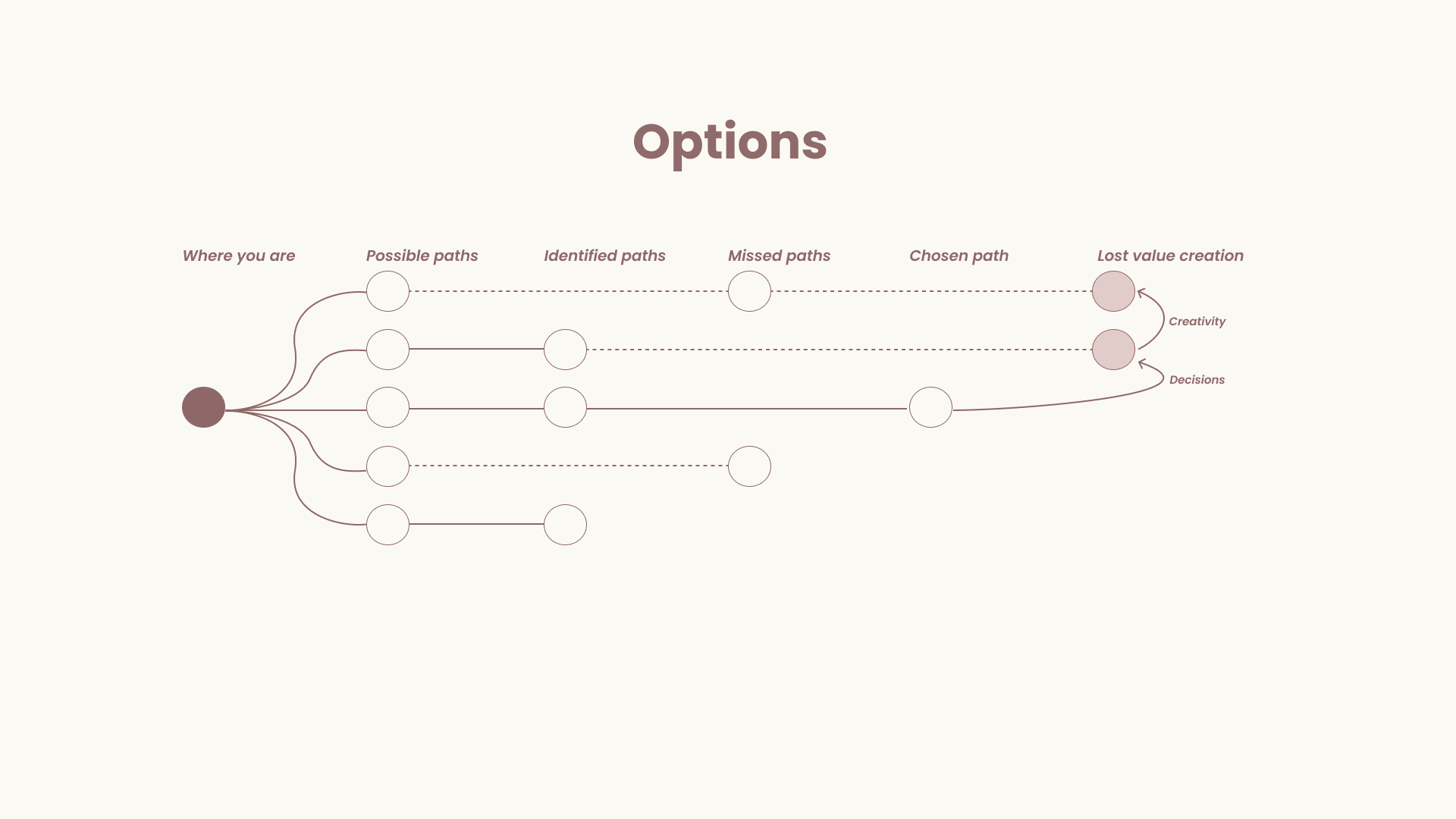
Finding starts with where you are. To navigate somewhere you must start with where you are. As the adage goes, “once you deeply understand the problem, you almost have the solution”.
Further, you cannot travel a path you don’t see.
Finding paths comes down to skills and knowledge. It’s about connecting dots. It's Creativity. And this can be cultivated.
Here's an example of path finding gone wrong
A company I worked with struggled with lower growth than expected.
Here's roughly how it went down:
"We need to invest more in marketing to increase awareness."
Didn't work.
“Pricing is too high”.
Nothing happened.
"The pricing model is wrong." In fact, they paid tons of money to hire a SaaS pricing consultant.
When that didn’t work, they focused on the partner channel.
"Direct sales does not scale, so we need to get partners to sell."
When partner’s didn’t deliver sales, the explanation had to be incentives.
"We need to incentive partners more. We need to give partners most of the economic gains for the first year."
When that didn't work, they blamed product. We need to make the product partner ready”.
After some time, frustration reach a tipping point. I was asked to help.
By doing the initial prep (as described here), I quickly found the following.
Red flag #1: we had churned 50 %
Red flag #2: support tickets were piling up
Red flag #3: Lots of customers were dissatisfied
Digging deeper, the reason was that focus had been shifted to growth. Instead of developing the product, new integrations were made (to open up new customer segments). Further, the organization was siloed. The development team lost touch with customer problems.
Once understood, it was relatively easy to fix. The development team were placed close to support, and we prioritised fixing the product and solving tickets. We also reduced burn to an appropriate level.
Almost immediately, the morale improved. Productivity increased manyfold. Customer satisfaction increased. Growth started materialising. And the trajectory of the firm changed. It is now among the most promising companies within its region.
One key takeaway is this: Management did not see the right path. They were blind to it. So they could not pursue it.
Next, if you find the path, you must also decide to pursue it.
Enter the Path Equation.
The Path Equation.
A path can be seen as an equation, as illustrated below.
Value of a path = - Upfront costs + P(break-even) x E(value | break-even)
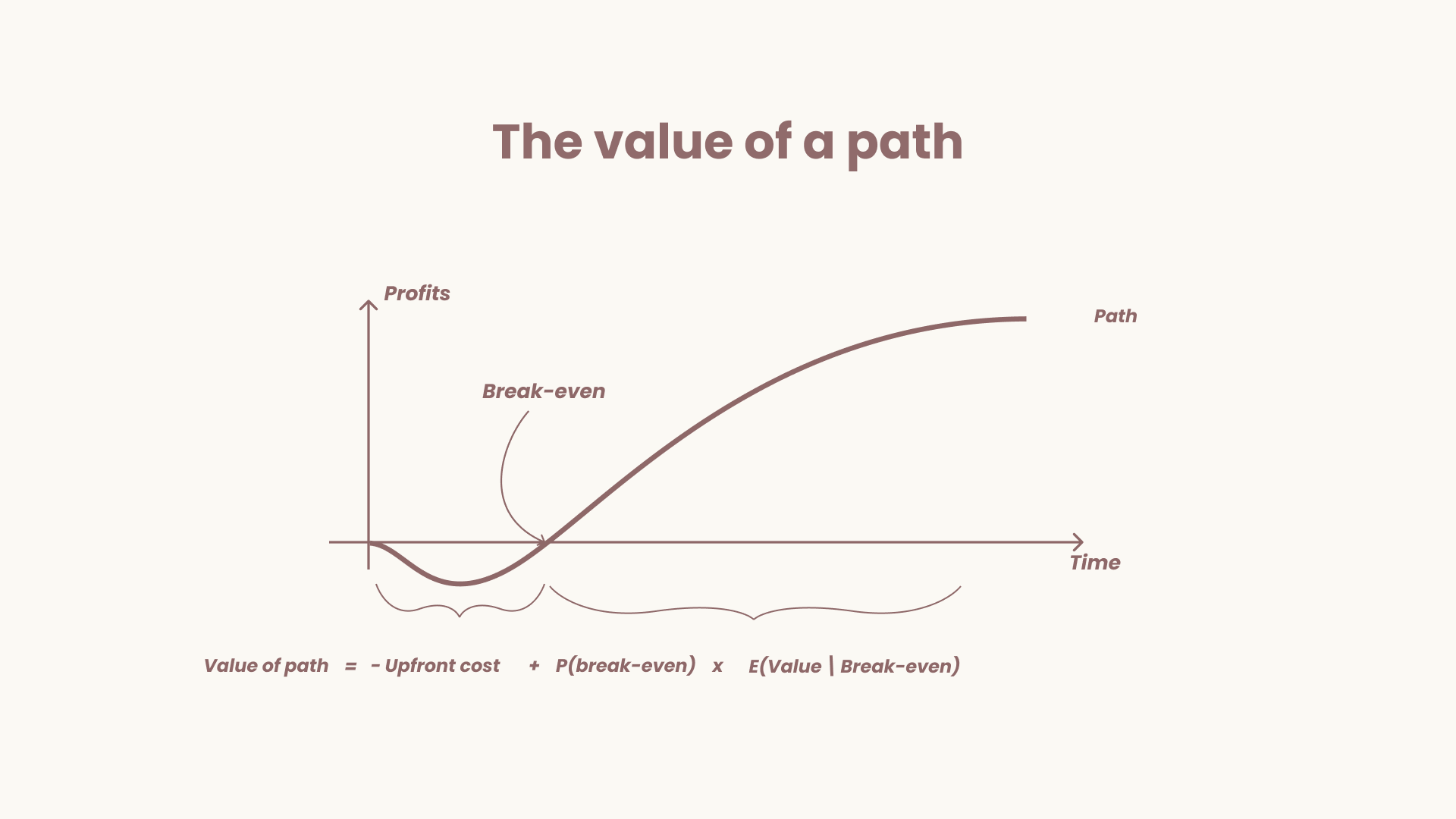
In the example above, the net result of management's approach was detrimental to value. Their choices both increased the upfront costs and dramatically decreased the probability of reaching break-even.
That’s it for now.
I’ll go into more in depth on these drivers in the series.
Love this part - path we did not find and path we did not choose. Such a nice way to express it!